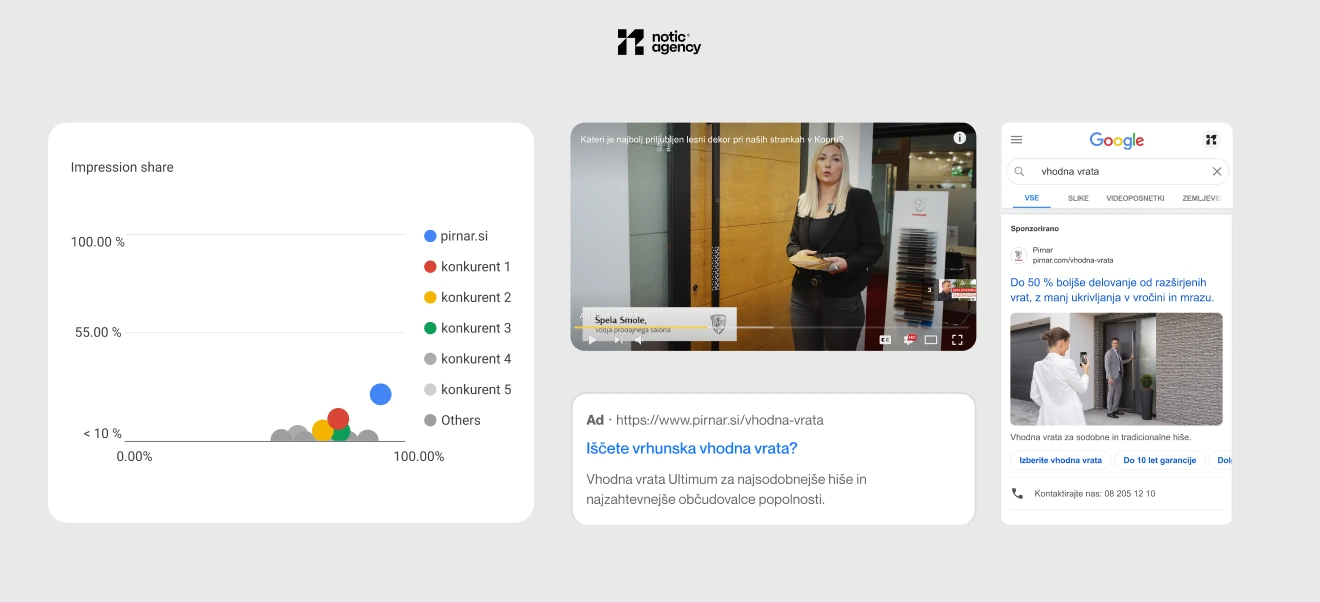
Google advertising It is a paid advertising system where you pay for every click on your ad. Google advertising allows your ad to appear in search results, on YouTube, in Gmail, and on millions of partner websites.
Average CPC The cost per click for Google Search Ads is €2.69. The average conversion rate is 4.4%. This means that every 23rd click results in a potential customer.
And these numbers are just averages. We've seen campaigns where CPA dropped below €8, and accounts where every conversion cost €300, even though the budget was reasonably large. The difference wasn't in the budget, it was in the setup.
In this article, we'll show you how Google Ads actually works, what most advertisers overlook, and where the opportunities are that the competition doesn't see.
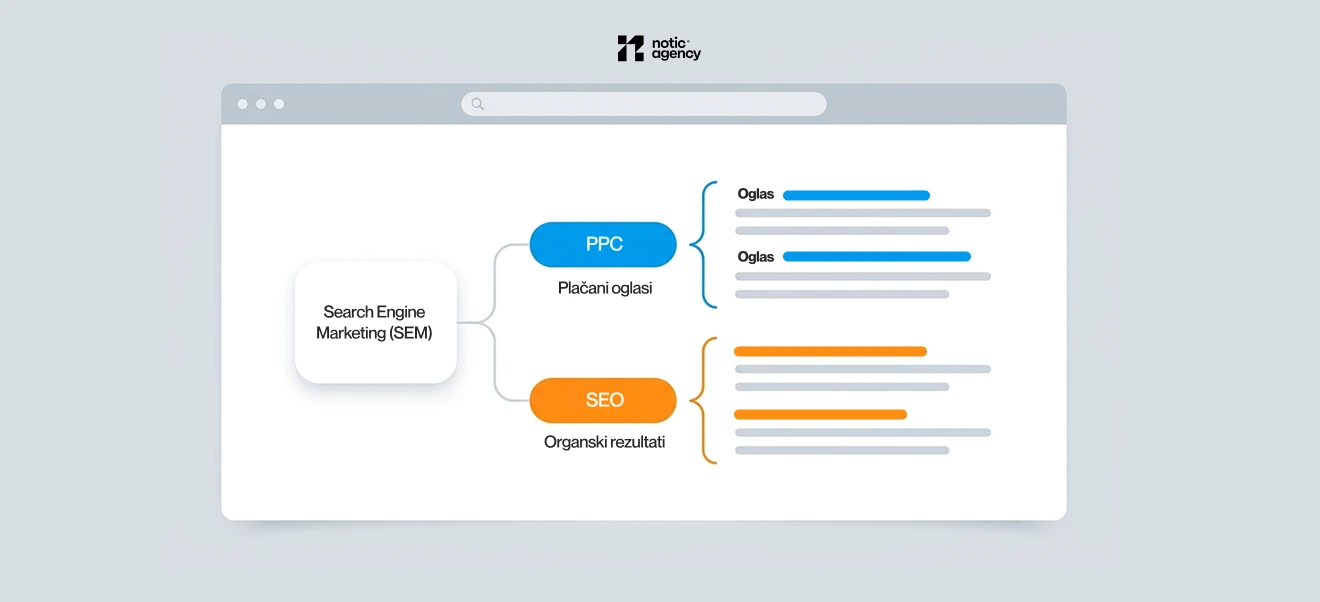
Google Ads is based on one simple principle: it captures the user who is already searching for a specific product or service. When someone types in “running shoes” or “custom entrance doors,” Google decides in a fraction of a second which ad to display and in what position.
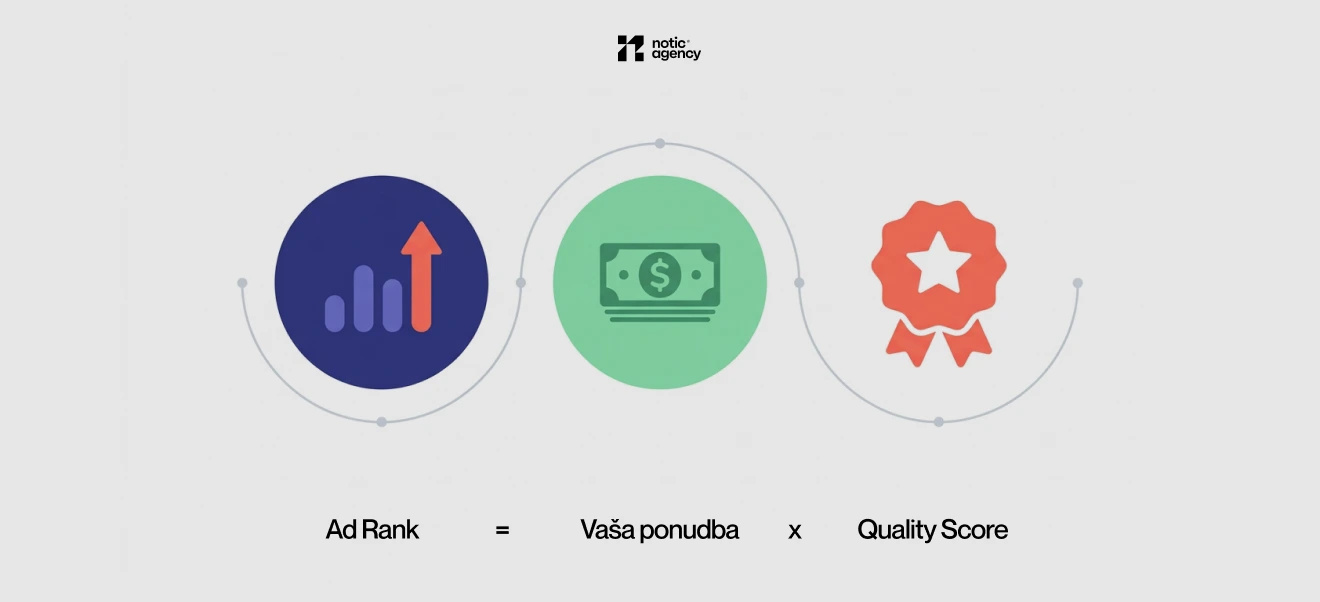
Not always does the highest bidder win at this auction.
Google calculates Ad Rank for each ad. This is a combination of your bid and Quality Score (from 1 to 10), which measures ad relevance, landing page quality, and expected click-through rate.
Primer Your maximum bid is €2, the Quality Score is 8. Competition is offering €3 but has a Quality Score of 4.
Vi: 2 × 8 = 16
Competition: 3 × 4 = 12
Your ad appears higher, and you pay less.
Improving Quality Score from 4 to 7 often has a greater impact on results than doubling the budget.
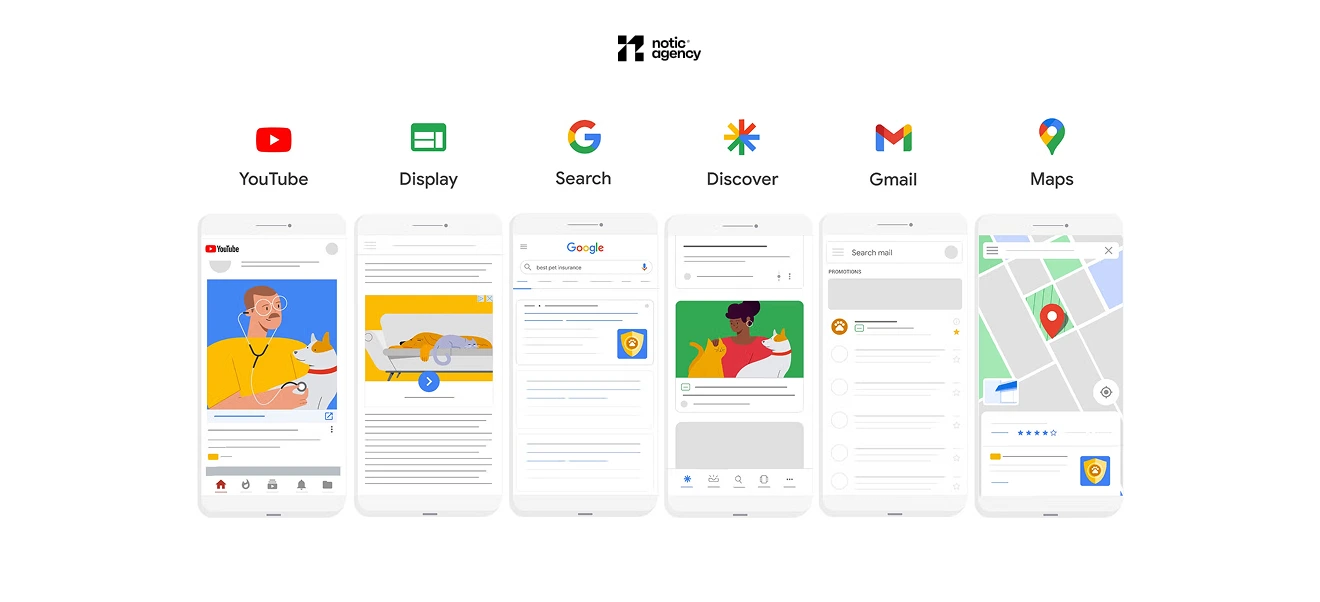
Performance Max (PMAX): A flexible campaign type that simultaneously covers all Google channels (Search, Display, YouTube, Gmail, Maps, and Discover). The algorithm itself decides where and to whom to show the ad. It only works well with conversion tracking set up and sufficient historical data. Without these, it often wastes the budget without clear results.
Demand Generation Successor to Discovery campaigns. Shown in Gmail tabs, Google Discover feed, and on YouTube. Targets users who are not yet actively searching, and visual creative is key to success. Works similarly to Meta ads: suitable for building awareness and remarketing.
Local Campaigns (Local / LSA): Local Services Ads appear above all other Google ads, including standard Search ads. You pay per lead, not per click.
Search
4,4 %
Existing demand
1 to 2 weeks
Display
0,57 %
Awareness, remarketing
3 to 4 weeks
YouTube
1 to 2 %
Product awareness
3 to 4 weeks
PMAX
Depending on the channels
Expansion of existing campaigns
4 to 6 weeks
Demand Generation
1 to 2 %
Remarketing
3 to 4 weeks
Local
High (call/avg.)
Local services
Immediately
Conversion rate: percentage of people who took the desired action after clicking (filled out a form, made a purchase, etc.).
You won't believe it, but it's possible. Get to know us and how we approach working with clients in our boutique digital agency.
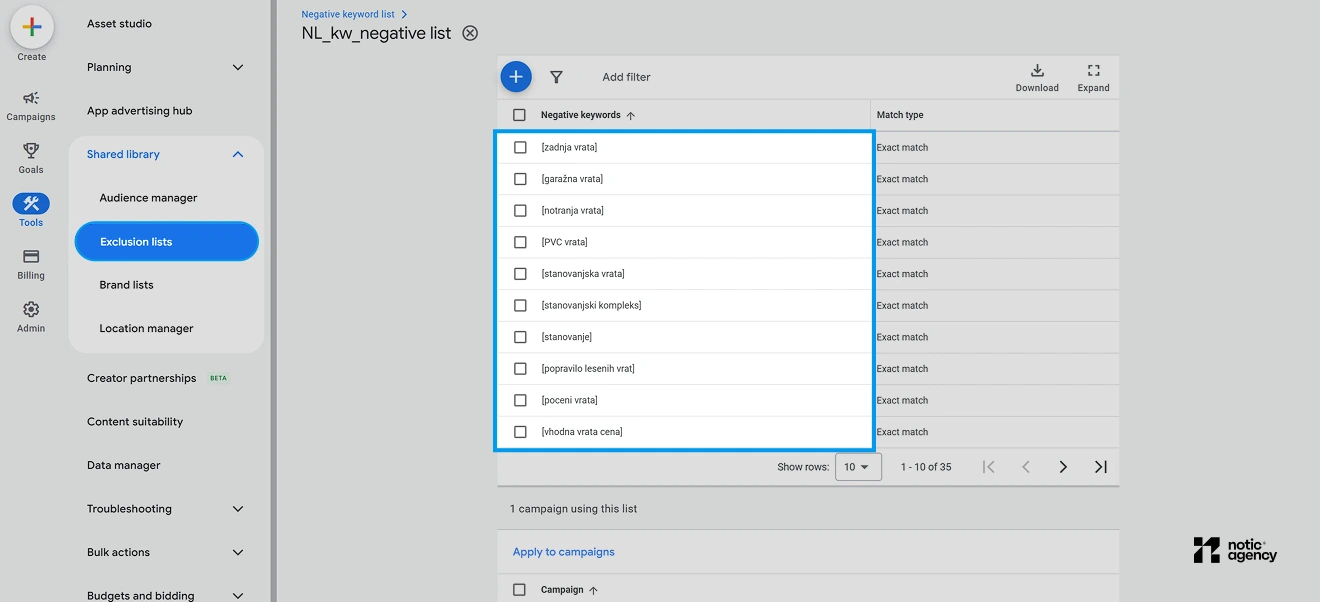
Most advertisers only think about which keywords to add. They forget about the ones they need to exclude.
Without negative keywords, a Google Search ad for “air conditioner” will show your ad for “how does an air conditioner work” and “air conditioner playing cards.” These are clicks that you pay for and will never convert.
Negative keywords are an investment with a 100% return: every click you prevent is money that stays in your budget.
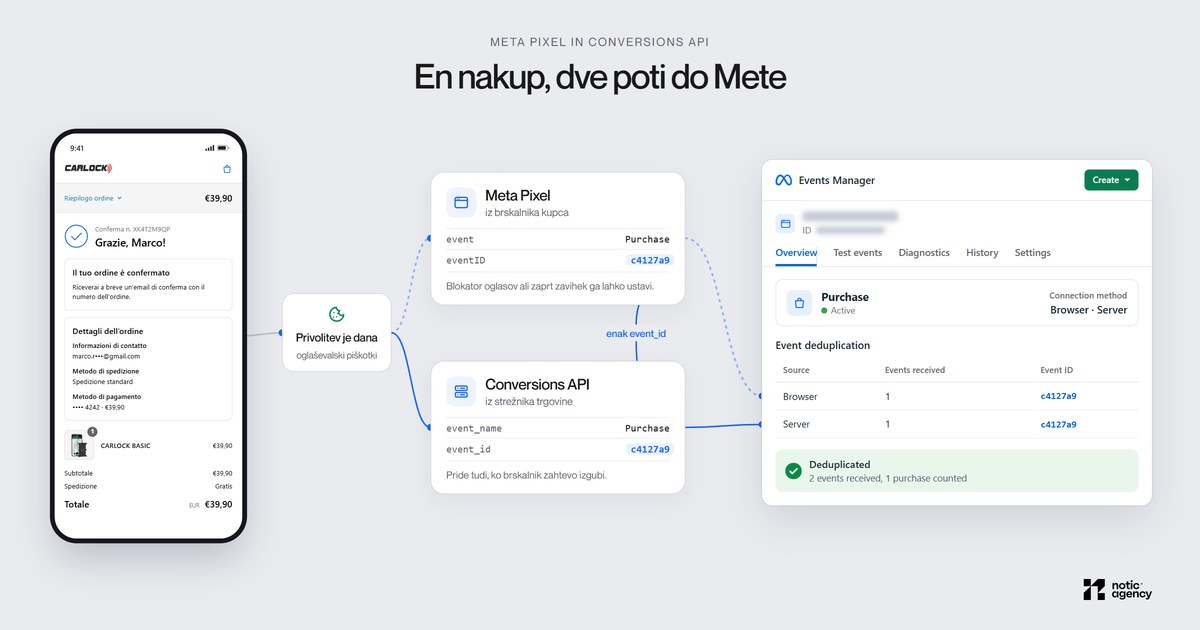
Advertisers with a Quality Score of 8 or higher pay, on average, 37% less per click than those with a Quality Score of 4 or lower, assuming the same ad position. Every euro you invest in improving your landing page pays off in the form of a lower cost per click.
Google Ads without conversion tracking is like driving blindfolded. Advertisers who don't have tracking set up don't know which ads are bringing in customers and which are just burning through budget. We've seen companies send money to keywords with zero conversion for years because they didn't know.
Before each campaign: Google Ads pixel, Google Analytics 4, call tracking, and thank you pages.
We started with analysis of all searched keywords in connection with heating and heat pumps, which are searched for approximately 20,000 times per month. We analyzed all search terms and segmented them based on the customer's intent when searching. That those who Search “buy a heat pump” does not yield the same content as “which heat pump is best,” as they search for different content.
Search ads We've established it as the primary channel for capturing inquiries. The logic is simple: someone who types “heat pump for house price” is already in the decision-making phase. The search intent is defined. Your task is simply to be visible at the right moment.
Conversion rate the conversion rate of search campaigns is significantly higher than any other format because the ad appears exactly when the customer is ready for the next step.
What have we achieved?
The answer depends on the industry, competition, and the quality of your ads.
Legal services
6 € - 15 €
2,5 %
€240 - €600
Insurance
5 € - 12 €
2,8 %
€180 – €430
Construction and Crafts
1,5 € - 4 €
3,5 %
$43 - $115
Local services
0,8 € - 3 €
5,0 %
$16 - $60
Health and Beauty
1 € - 3 €
3,8
€26 - €92
CPC — Cost Per Click. How much you pay each time someone clicks on your ad.
CVR - Conversion Rate. The percentage of people who completed a form, made a purchase, etc. after clicking.
CPA — Cost Per Acquisition. How much one conversion (one lead, one sale, etc.) costs you.
A high CPC isn't necessarily bad. A lawyer with a CPC of €12 and a CPA of €400, who acquires a client worth €3,000, has a ROAS of 7.5. While this might seem extremely expensive at first glance, it's definitely a sensible investment.
The true measure is always CPA, not CPC.
For the testing phase of Google advertising, we recommend a minimum of €25 to €30 per day (€750 to €900 per month). With less than this, the algorithm does not have enough data for optimization. For a serious campaign in a competitive industry, a realistic starting monthly investment with various types of campaigns is around €1,500 or more. Of course, it also depends on the number of active markets, competitor activity, industry complexity, and so on.
Most advertisers compare CPC (cost per click). This is a mistake. Facebook (Meta) has a lower average CPC (€0.97 vs. €2.69 for Google Ads), but Google has a higher conversion rate (4.4 % vs. 1.85 %).
When you calculate CPA (cost per acquisition), the difference is often much smaller than it appears at first glance.
Targeting Basis
Search intent, keywords
Interests, demographics, behavior
Buyer phase
Middle and bottom of the funnel
All stages of the funnel
Average CPC
2,69 €*
0,97 €*
Average CVR
4,40 %
1,85 %
Minimum Budget
€10-20/day for test
€5-10/day for testing
Result speed
1-2 weeks
3-4 weeks
Visual creative
It is necessary (for searching)
Key to success
Remarketing
Display + YouTube
Feed, Stories, Reels
Best for
Capturing existing demand
Lead generation, e-commerce, and demand generation
Google advertising works better when:
Facebook advertising works better when:
Pirnar offers high-quality entrance doors. This is not an impulse purchase. When someone is building or renovating, they think about it for months before they actually buy.
Before our collaboration, they already had Google advertising. But the campaigns were not set up at the level that such a product requires.
With the same budget, we achieved 4x more leads.
We built a sales funnel that guides the customer from initial contact to submitting an inquiry. Google search ads captured those who were actively searching. Facebook and Instagram built awareness among those who were building or renovating but hadn't started searching yet.
Behind the scenes, there was systematic work that most campaigns lack. Separate negative keyword lists for each EU market, a direct connection to the Salesforce CRM system for optimization towards qualified leads, improved conversions based on recommendations from Google's official team, and display remarketing for everyone who entered the configurator but did not complete it.
What have we achieved?
After years of working with advertising campaigns, we see the same mistakes over and over again.
1. Channel selection by popularity, not by goal: “Everyone is on Google” is not a strategy. Choose your channel based on where your customer is and what they want to do at that moment.
2. Comparing CPC instead of CPA Lower CPC doesn't mean a better campaign. It just means a cheaper click. Look at the cost per conversion.
3. Abandoning the campaign too early: The Google Ads algorithm needs time to learn. Without at least 30 to 50 conversions during the learning period, you won't see real results. Campaigns that seemed “hopeless” after two weeks became profitable after six weeks.
4. Creative input in all formats: An ad that works on Google doesn't work on Instagram. Each channel requires a customized message and format.
5. Without remarketing: Remarketing is one of the best investments in digital advertising. The average B2C customer needs 7 to 13 leads from a brand before making a purchase. Without remarketing, you lose everyone who was close to making a decision but didn't convert on the first click.
6. Without negative keywords: Without this, you're paying for queries that have nothing to do with your service. This is one of the most common reasons for a high CPA in the first few months.
We identify problems, look for opportunities for improvement and implement them using proven methods. It's no coincidence that 95 % of our customers stay with us.
Setting up a Google Ads campaign has six steps if you don't already have a Google advertising account. Each step affects the performance of all subsequent steps.
1. Create an account: Create an account on the Google Ads website by entering your business name, website URL, and setting your time zone and currency (EUR, your local time zone).
2. After opening an account, set up the appropriate tracking: Before the first campaigns, conversion tracking must be set up correctly. Google Ads connected with GA4, tracking purchases or form submissions. Without this, Google doesn't have enough conversion data and won't be able to optimize campaigns.
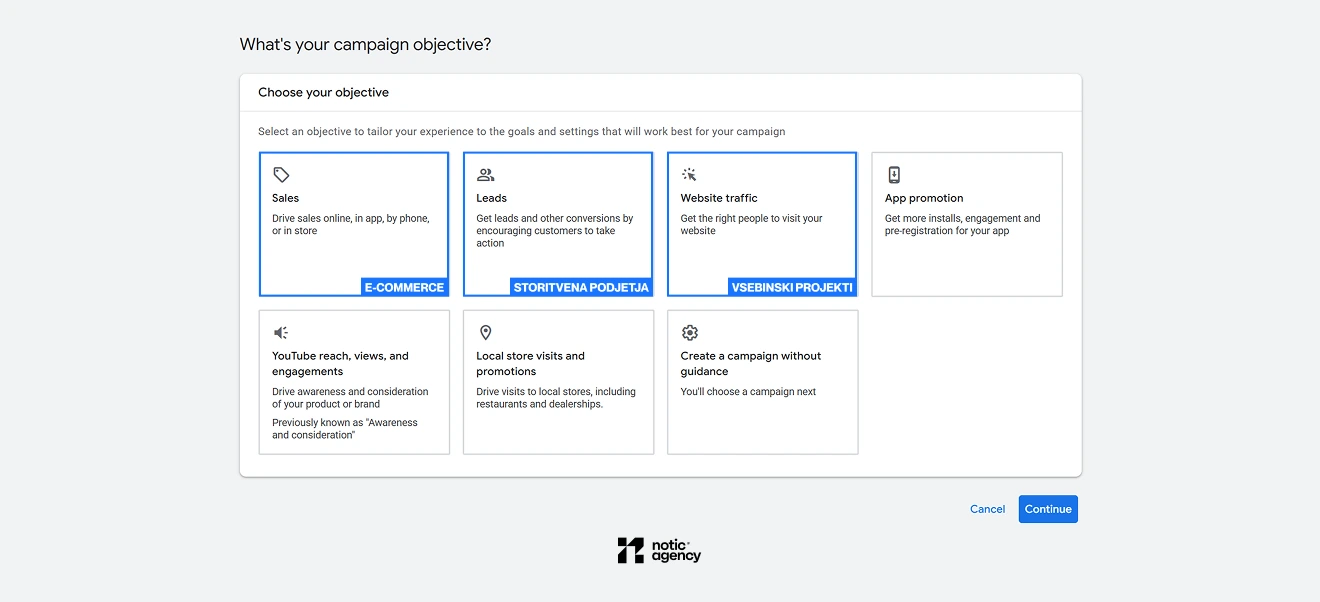
3. Define the campaign goal
– Sales for e-commerce
– Leads for Service Companies
– Promise (Website Traffic) for increasing traffic and recognition
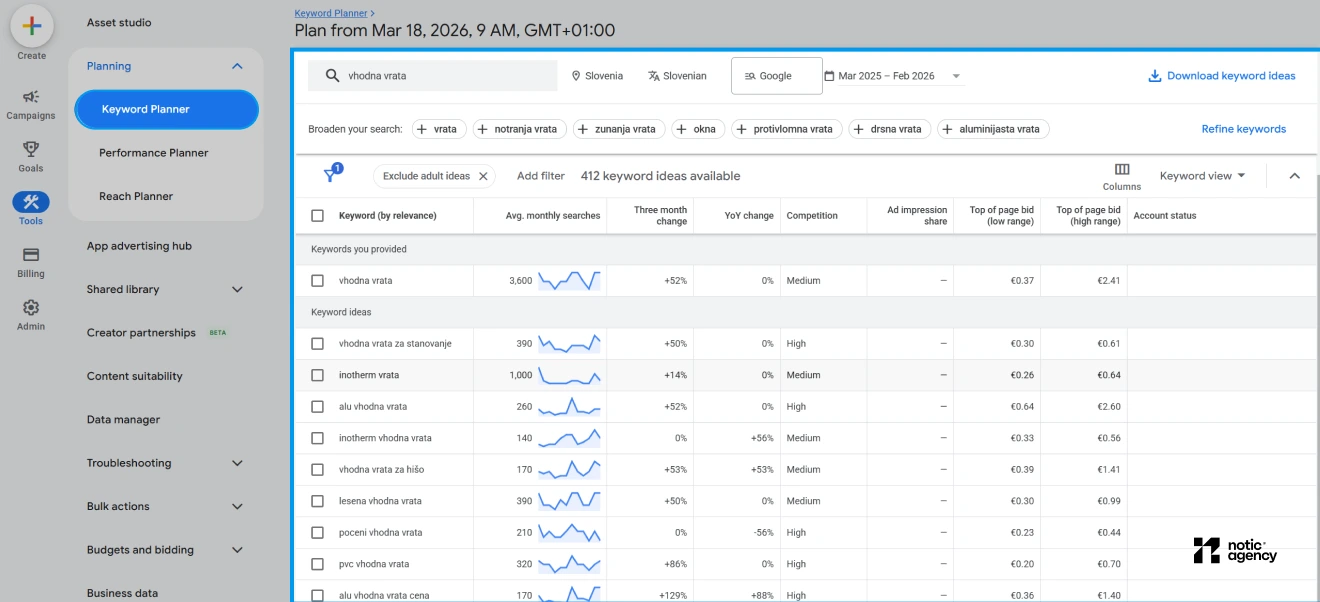
4. Perform keyword analysis: Google Keyword Planner is free. Find 20 to 30 relevant terms. Create a list of negative keywords alongside your search for positive ones.
5. Set geographic targeting and budget: Target only the areas where you actually do business. To start, we'll use the Manual CPC bidding strategy, where we set an estimated cost per click. We'll switch to Maximize Conversions once we have at least 30 conversions in 30 days.
6. Create tightly structured ad groupsOne advertising group = one thematic group of keywords. Do not mix “bathroom remodel” and “kitchen remodel” in the same ad group.
Yes, for most companies offering services or selling products with a clear search query. Google Ads is one of the few advertising channels where you reach a customer exactly at the moment they are actively looking for a solution. This is an advantage that no other platform has to the same extent.
Watch out! Without proper tracking, relevant keywords, and a landing page that converts, it's just an expensive way to get clicks without results. A good campaign isn't the one with the most clicks. It's the one where every euro spent brings a measurable result back.
If you want to know how many inquiries are currently “slipping away” from you, or to check why existing campaigns aren't delivering what they should, we're here to talk.