What to do?
In digital marketing, broad match keywords still divide opinion among the agencies and companies we work with. Some praise their versatility, others warn that they can quickly drain advertising budgets.
The Broad match has changed significantly in recent years. Google's algorithm now understands users' intentions in ways that were not possible before. This means that broad match can reach customers who are actually converting but would never have been found with exact or phrase match.

Broad match is a type of keyword matching in Google Ads that helps your ads appear in a wider range of searches related to your chosen keywords.
Unlike exact match or phrase match, which target specific phrases, broad match also captures synonyms, related terms and other variations that Google's algorithm deems relevant.
This means that your advert reaches more people who may be interested in your product or service, even if they don't type in the exact words you've chosen.
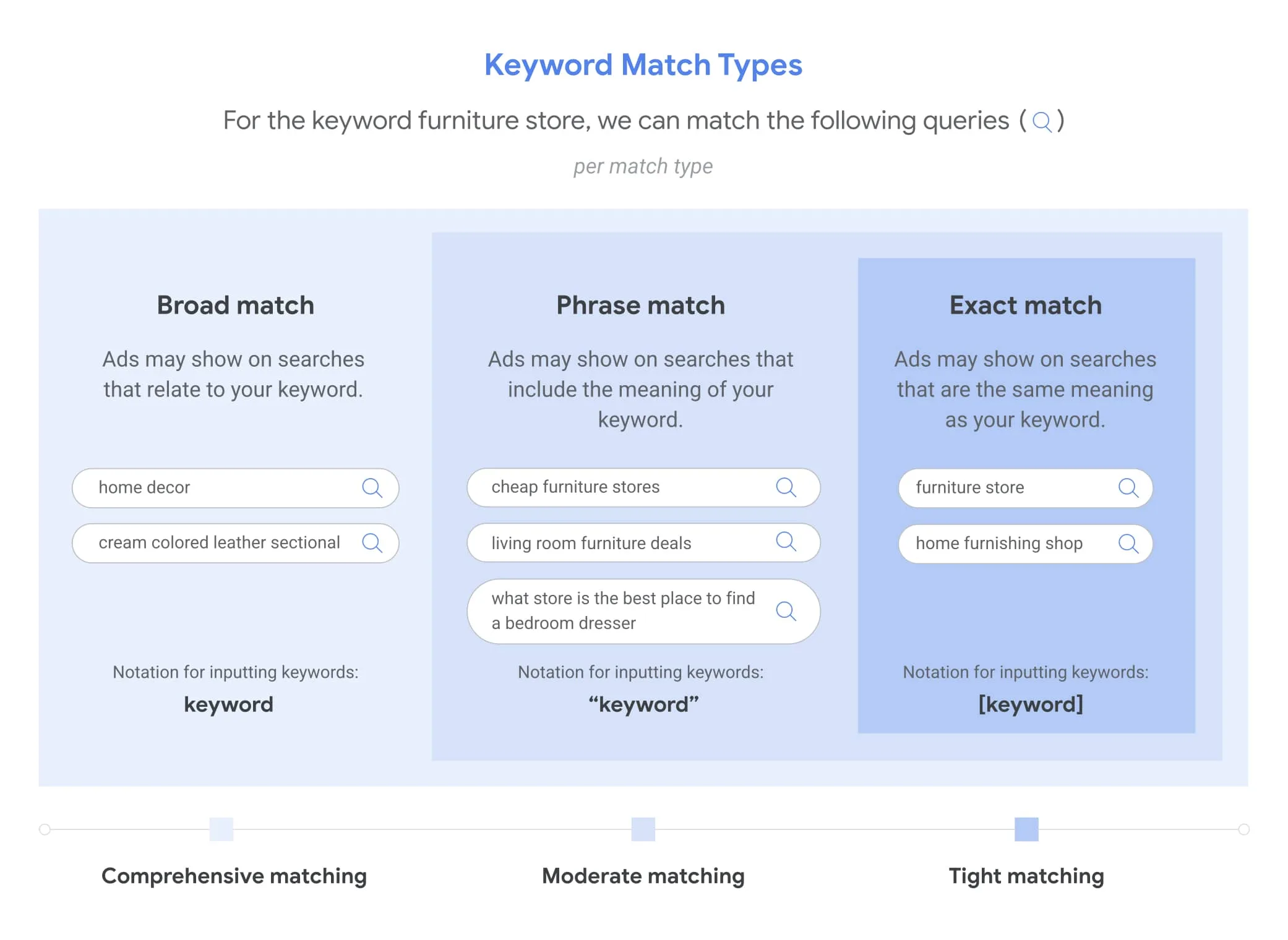
Exact Match
Your ad only appears when someone types in the exact keyword or very similar variations of it. For example, if you offer “heating repair” with exact match, your ad will only appear for searches that are very close to that keyword.
Phrase Match
Your ad will appear when the search term includes your chosen keyword phrase, but may also include other words before or after it. So “heating repair” might show up for “emergency heating repair” or “new heater near me” in a “phrase match”, but not for synonyms such as “HVAC”.
Broad Match
Your ad will appear for searches that are related to the keyword in a broad sense, including synonyms and other related terms. It is less precise, but captures a much wider audience.
Broad match
AI-led audience search, ads pre-screened before auction
AI-led audience search, ads pre-screened before auction
Phrase match
"living room furniture"
Searches that include the relevance of your keyword
Exact match
"living room furniture"
"living room furniture"
We identify problems, look for opportunities for improvement and implement them using proven methods. It's no coincidence that 95 % of our customers stay with us.

Broad match is becoming increasingly important as Google uses advanced artificial intelligence and machine learning to better understand the intent behind every search. Instead of relying solely on specific keywords, Google can now understand what people are searching for, even if they use completely different terms.
This means that even smaller companies can reach more of the right customers without having to hand-pick every possible keyword variation.
Below, we'll look at what these changes mean for smaller teams and how you can adapt to get the most out of broad match.
Broad match keywords are ideal for companies in large, broad industries. Imagine your dishwasher ad showing up when someone searches for “kitchen appliances”, or your local contractor ad showing up when someone searches for “kitchen renovation”. Both of these examples can result in lots of clicks relevant traffic, even if the user has not entered the correct keywords, that you have set.
Until now, advertisers have relied mainly on exact and phrase match keywords to target specific search terms and avoid irrelevant clicks. This is particularly useful for smaller teams with limited budgets, where every click counts.
For smaller companies working on a limited budget, Google's shift to broad match brings both opportunities and challenges.
Broad match can simplify keyword management, but it also brings new dynamics that you need to adapt to. Let's look at what this means for your advertising strategy.
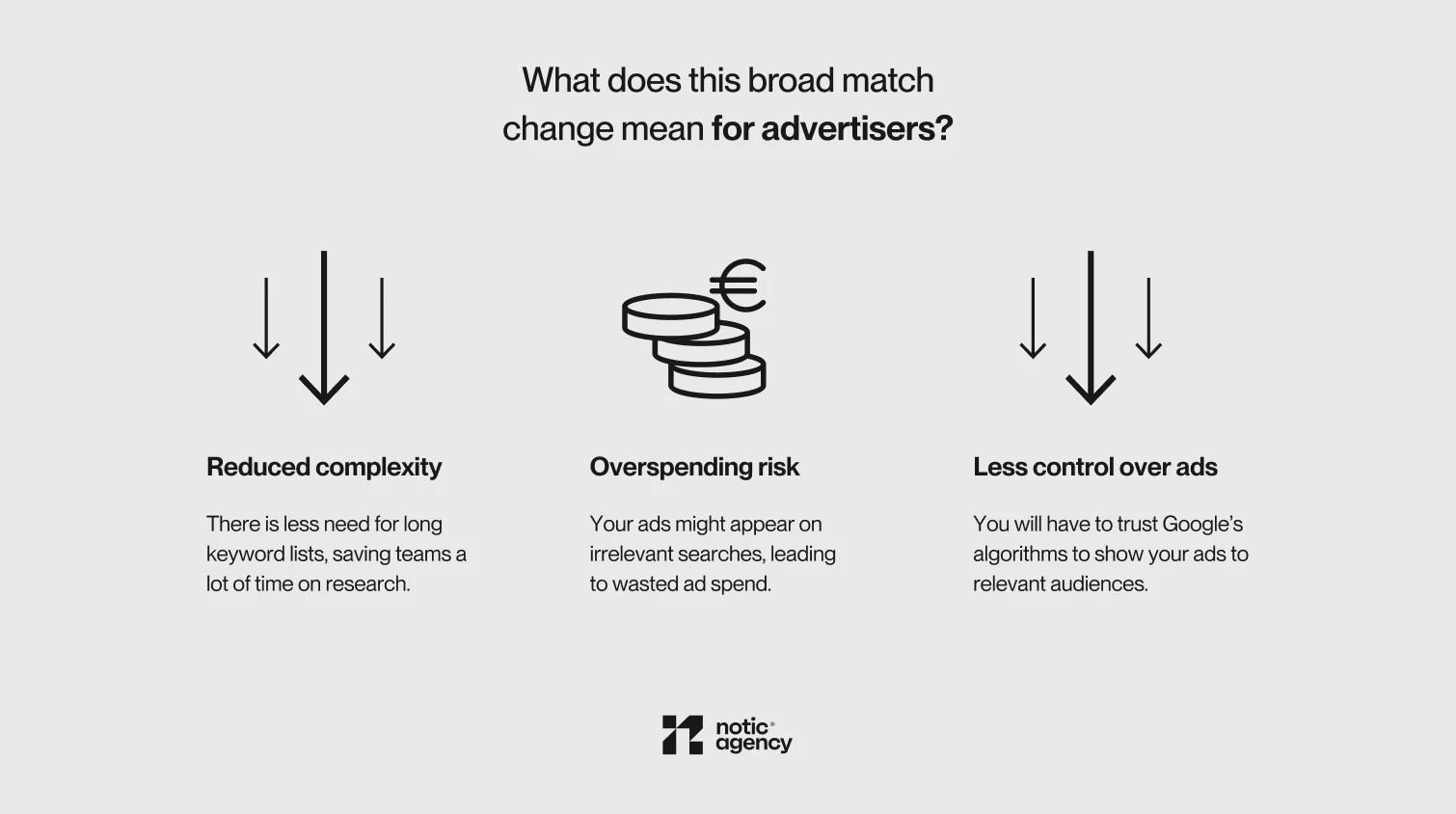
Broad match can sometimes cause your adverts to appear in searches that are not relevant to your business.
For example, if you target “home renovation services” with broad match, your ad might show up in searches as “DIY home repair tips”, which is not the same as the services you actually offer.
This can lead to clicks from people who are unlikely to convert, which can quickly drain a small budget.
This results in clicks from people who are unlikely to become customers, which can quickly drain a small budget. More irrelevant traffic means your advertising budget doesn't last as long and requires regular monitoring to ensure you're not paying for clicks that don't deliver results.
You won't believe it, but it's possible. Get to know us and how we approach working with clients in our boutique digital agency.
By using broad match keywords, advertisers lose some control over which search terms trigger their ads and rely more on Google's algorithm. For smaller teams, this means they have to trust Google to serve their ads to the right audience.
Although Google's machine learning is advanced, it doesn't always hit the mark, especially if your target audience has specific needs or buying behaviour. The key to managing this loss of control is to use tools that allow you to target more precisely within broad match, such as negative keywords, smart bidding strategies and audience targeting.

Today, broad match uses a much wider range of signals.
That's why sometimes your ad appears in a search you didn't expect, but still results in a conversion. Behind the scenes, Google is connecting data beyond keywords.
Here's what actually happens when someone searches for a keyword:
That's why you'll sometimes see broad match keywords driving conversions on seemingly unrelated searches. Google doesn't guess, it finds patterns in user behaviour that we can't see.
Most advertisers still treat broad match as if it's 2020, using it purely for volume and then getting frustrated when the quality of traffic drops.
The Broad match is not bad in itself. But most people use it incorrectly, and then blame the match type instead of their own preferences. Here are the most common mistakes we see in accounts, and how to fix them:
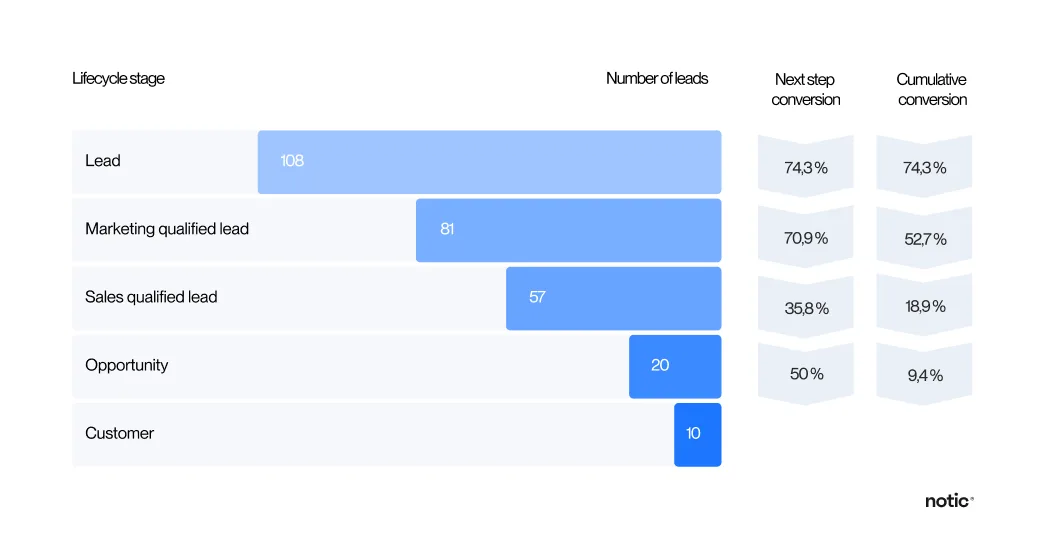
A low cost per lead looks great until you look deeper. Broad match often yields the cheapest leads on paper. But when you follow them through the sales funnel, many disappear. They don't pick up the phone, they're not qualified, or they were just curious.
A €50 lead that becomes a customer always beats ten €5 leads that lead to nothing.
What to monitor instead:
Set the correct tracking. If possible, connect your CRM to Google Ads and import offline conversions so the algorithm knows which leads actually became customers. This teaches Google what a good lead looks like for your business.
Assign values to each conversion. If certain leads are worth more (higher deal value, better match, faster sales cycle), assign them higher values. The algorithm will optimise for these instead of only hunting for quantity.
Keep track of metrics beyond the first completed form. Look at the ratio of leads to opportunities, the ratio of leads to customers and the actual revenue by source. These numbers tell you what is actually working.
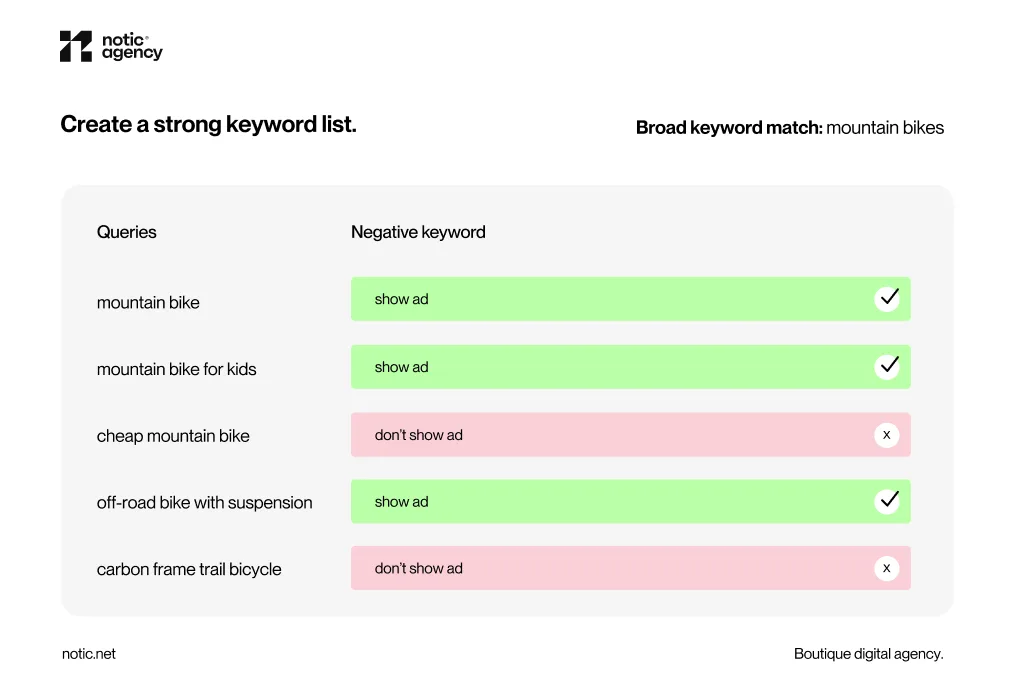
Using broad match without negative keywords is like driving without brakes. You'll go fast, but you won't be able to control where you end up.
Without negative keywords, your campaigns will not be profitable. Google's algorithm for automatically setting click prices is a powerful tool, but it needs clear boundaries to work at its best.
Start with this:
First, add negative keywords at account level. Once added at account level, they protect all your campaigns. These are words and phrases that may have already appeared in your account but that you don't want to pay for clicks on.
Check the search terms report every week to start with, and every two weeks as things settle down. Add 5 to 10 negative keywords each time.
The aim is to filter out searches that have no chance of converting, so that the algorithm can focus on what actually works.
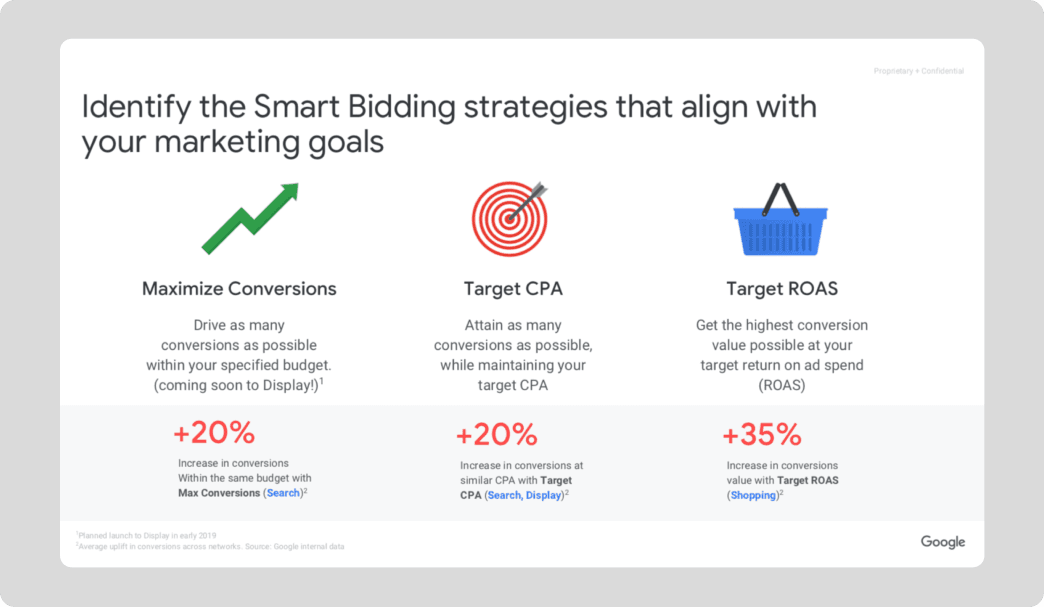
Broad match needs the right environment to work. If you give it too little budget or the wrong bidding strategy, it will fail before it even starts.
Only use Broad Match when you have enough daily budget to allow the algorithm to learn. You need enough spending to generate meaningful conversion data. Expect a higher initial spend in the learning phase. This is normal.
Don't panic and don't cut the budget in the first week. Give campaigns 2-3 weeks and at least 50 conversions (if possible) before making major budget decisions.
What this looks like in practice:
Setting your budget:
Approach to bidding (bidding):
It's just a tool that requires more settings and more trust in the system than most advertisers like.
The old approach of strict control over keywords is disappearing. Google's algorithms now access behavioural signals that manual targeting could never reach. To resist this change is to miss opportunities. But that doesn't mean you should blindly trust the algorithm.
So how to approach:
Give the system room to work, but set clear boundaries. Use smart bidding, but follow up on what is actually important for your business. Let broad match do the research, but build a solid base of negative keywords first.
The advertisers who are currently winning with broad match are not the ones throwing money at it and hoping for the best. They are the ones who understand how modern search advertising actually works. They monitor the quality of leads, not just the quantity. They organise their accounts correctly. They give campaigns time to learn.
Start here if you are testing a broad match:
Choose 3-5 of your best performing keywords. Move them to broad match in a separate smart bidding campaign. Set up proper conversion tracking and negative keywords. Allow one month with an appropriate budget. Then look at the actual results, not your assumptions about how it should work.
You may be surprised by what conversions bring. And that's the point.
Probably you
Also interested in:
Probably you
Also interested in: