
Why is broad
keyword match perhaps usable in 2026.
- Category Online advertising
- Keywords Google Ads, Keywords
ON THIS PAGE
INTRODUCTION
Broad keywords can bring serious
results, or whether you're completely sung to
Budget.
What to do?
In digital marketing, the broad match keyword debate continues to divide opinion among the agencies and entrepreneurs we spoke to. While some praise their versatility, others point to their potential to drain advertising budgets.
The Broad match has changed significantly in recent years. Google's AI can now understand user intent in ways that were not possible before. This means that broad match can find converting customers that would not have been reached by exact or phrase match.

WHAT IS WIDE?
What is broad match in Google Search Ads?
Broad match is a type of keyword matching in Google Ads that helps your ads appear in a wider range of searches related to your chosen keywords.
Unlike exact match or phrase match, which target specific phrases or flash variations, broad match is designed to capture a wide range of searches that may include synonyms, related terms or other variations that Google's algorithms deem relevant.
This allows your ad to reach more people who may be interested in your product or service, even if they don't type in the exact words you've targeted.
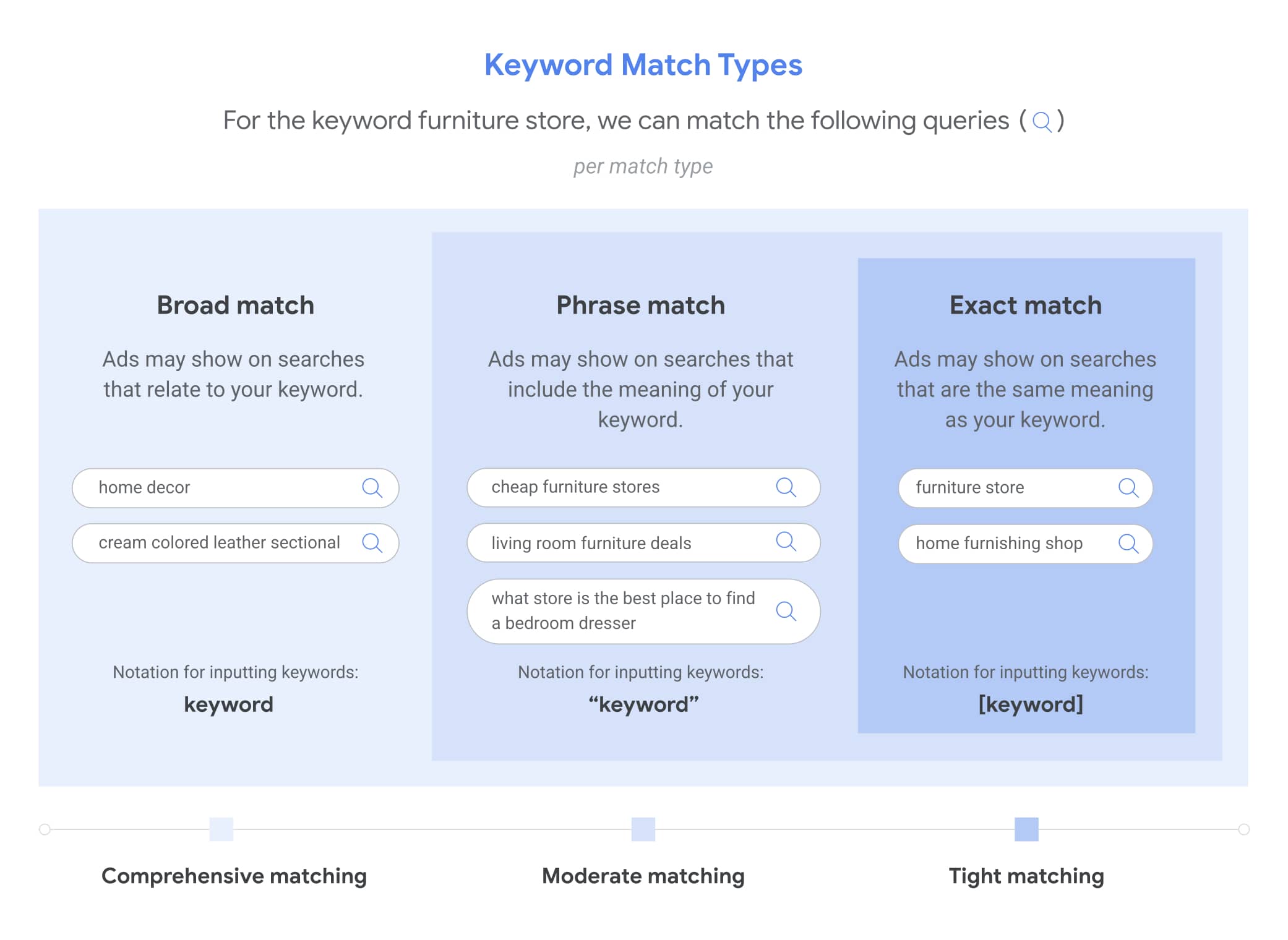
TYPES OF ENTRY
Exact Match
Your ad shows only when someone types in the exact keyword or close variations. For example, bidding on “heating repairs” in exact match would only display your ad for searches very close to that original keyword.
Phrase Match
Your ad shows when the search term includes your chosen keyword phrase but can also have other words before or after. So, “heating repairs” in phrase match might show for “emergency heating repairs” or “new heater near me,” but not for synonyms like “HVAC.”
Broad Match
Your ad shows for searches that relate to the keyword in a broader sense, including synonyms and other related terms. It's less precise, but it captures a much wider audience.
Broad match
pendant lights
Searches that relate to your keyword
- kitchen island lighting
- modern hanging lamps
- ceiling fixtures
Phrase match
“pendant lights”
Searches that include the meaning of your keyword
- bronze pendant lights
- pendant lights for dining room
- affordable pendant lights
Exact match
“pendant lights”
“pendant lights”
- pendant lights
- hanging pendant lights
Digital strategy that finally helps you reach your goals?
We identify issues, find ways to improve, and execute them using best practices. There is a reason 95% of our clients stay with us.

NEW UPDATES FOR BROAD MATCH
What is changing with Google Ads and Broad Match?
Broad match is becoming increasingly important as Google uses advanced artificial intelligence and machine learning to better understand the intent of searches. Instead of relying solely on specific keywords, Google can now understand what people want, even if they use a different language.
This approach can help smaller businesses and affiliate marketers reach more potential customers without having to hand-pick every possible keyword variation. In the following sections, we'll explore what these changes mean for smaller teams and how you can adapt to make the most of broad match.
Google's latest focus on broad match is part of a broader strategy to make advertising more intuitive and user-centric. With advances in artificial intelligence and machine learning, Google wants to understand what users are thinking when they search for something, even if the exact keyword or phrase is not used.
Broad match keywords can be ideal for companies in large, slightly generalised industries. Think of seeing an ad for a dishwasher when someone searches for “kitchen appliances” or for a local contractor when they search for “kitchen renovation”. Both of these examples can bring in a lot of clicks from relevant traffic, even if it wasn't the direct keyword that the marketer typed in.
WHAT YOU NEED TO DO
This means less reliance on exact match keywords in the future
Broad match is becoming increasingly important as Google uses advanced artificial intelligence and machine learning to better understand the intent of searches. Instead of relying solely on specific keywords, Google can now understand what people want, even if they use a different language.
This approach can help smaller businesses and affiliate marketers reach more potential customers without having to hand-pick every possible keyword variation. In the following sections, we'll explore what these changes mean for smaller teams and how you can adapt to make the most of broad match.
Google's latest focus on broad match is part of a broader strategy to make advertising more intuitive and user-centric. With advances in artificial intelligence and machine learning, Google wants to understand what users are thinking when they search for something, even if the exact keyword or phrase is not used.
WHAT CAN GO WRONG
Risk of irrelevant traffic and higher ad costs
However, broad match can sometimes lead to your ads appearing in searches that are not completely relevant to your business.
For example, if you target “home renovation services” with broad match, your ad might show up in searches as “DIY home repair tips”, which might not match the services you actually offer.
This can lead to clicks from people who are unlikely to convert, which can quickly drain a small budget.
This can be a serious concern for small businesses and affiliate marketers. Higher volumes of irrelevant traffic mean that advertising budgets may not stretch as far and require careful monitoring to avoid overspending on clicks that do not deliver value.
A digital agency that will actually listen to you?
You won't believe it, but it's possible. Get to know us and how we approach working with clients in our boutique digital agency.

LESS CONTROL
Less control and more dependence on Google's Algorithms
With broad match, advertisers give up some control over which specific search terms trigger their ads, relying more on Google's AI to make those decisions. For small teams, this means there's a need to trust Google's algorithms to show ads to relevant audiences.
While Google's machine learning is advanced, it doesn't always get it right, especially if your target audience has niche needs or specific buying behaviour. The key to managing this lack of control is to focus on the tools that can refine your targeting within broad match, such as negative keywords, smart bidding strategies, and audience targeting.

MAIN CHANGES WITH BROAD MATCH
What changed with broad match?
Today, in 2025, broad match taps into a much wider pool of signals, things like user search history, device, location, time of day, and broader behavioural patterns.
That's why sometimes your ad shows up for a search you didn't expect and still converts. Google is connecting dots behind the scenes that go beyond just keywords.
Here's what really happens when someone searches for a keyword:
Google analyses their recent search history
It looks at their device type and location
It considers time of day and seasonal patterns
It evaluates dozens of other behavioural signals
That's why you'll sometimes see broad match keywords converting on seemingly unrelated searches. Google isn't just guessing, but instead finding patterns in user behaviour that we can't see ourselves.
Most marketers still treat broad match like it's 2020. They use it as a pure volume play, then get frustrated when traffic quality tanks.
HOW TO GET GOOD RESULTS
So, how to actually get good results with broad match?
Broad match isn't inherently bad. But most people use it wrong, then blame the match type instead of their setup. Here are the most common mistakes we see in accounts, and what to do instead:
1. Track lead quality, not just volume
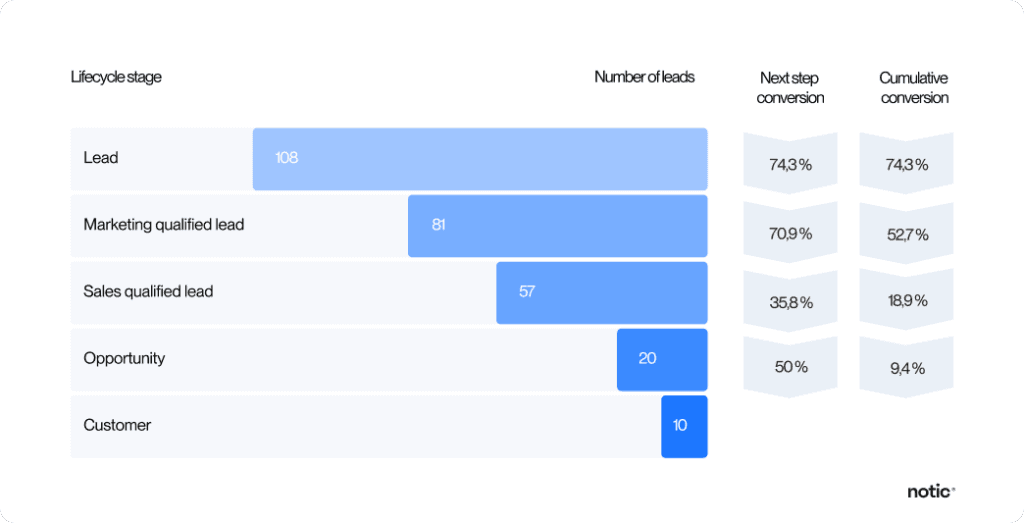
You see a low cost per lead and think you're winning. You're probably not. Broad match often delivers the cheapest leads on paper. But when you track those leads through your sales funnel, many disappear. They don't answer calls. They're not qualified. They were just curious.
A $50 lead that becomes a customer beats ten $5 leads that go nowhere. Every single time.
What to track instead:
Set up proper tracking: Connect your CRM to Google Ads if you can. Import offline conversions so the algorithm knows which leads actually closed. This teaches Google what a good lead looks like for your business.
Use conversion values. If certain leads are worth more (higher deal size, better fit, faster sales cycle), assign them higher values. The algorithm will optimize for those instead of just chasing volume.
Track metrics beyond the initial form fill. Look at lead-to-opportunity rate. Lead-to-customer rate. Actual revenue per source. These numbers tell you what's really working.
2. Create a strong negative keyword list
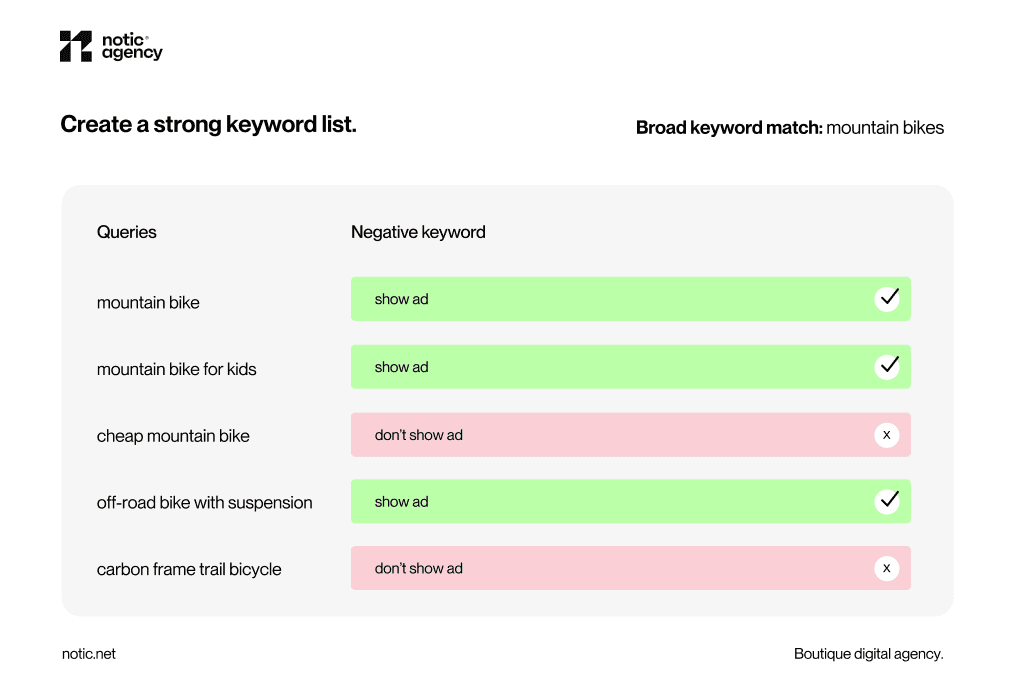
Running broad match without negative keywords is like driving without brakes. You'll move fast, but you can't control where you end up.
Negative keywords aren't optional. They're the guardrails that keep your campaigns profitable. Smart bidding is powerful, but it needs boundaries to perform at its best.
Start with these:
Add account-level negatives first. Apply them once at the account level and they protect all your campaigns. Broad terms that might've appeared in your account before but are not something you want to bid on.
Review your search terms report weekly when you start, then every two weeks once things stabilise. Add 5-10 negatives each time. This is ongoing work, not a one-time task.
The goal isn't to block everything that looks weird. It's to eliminate searches with zero chance of converting so the algorithm can focus on what actually works.
3. Set up your budget and bidding strategy correctly
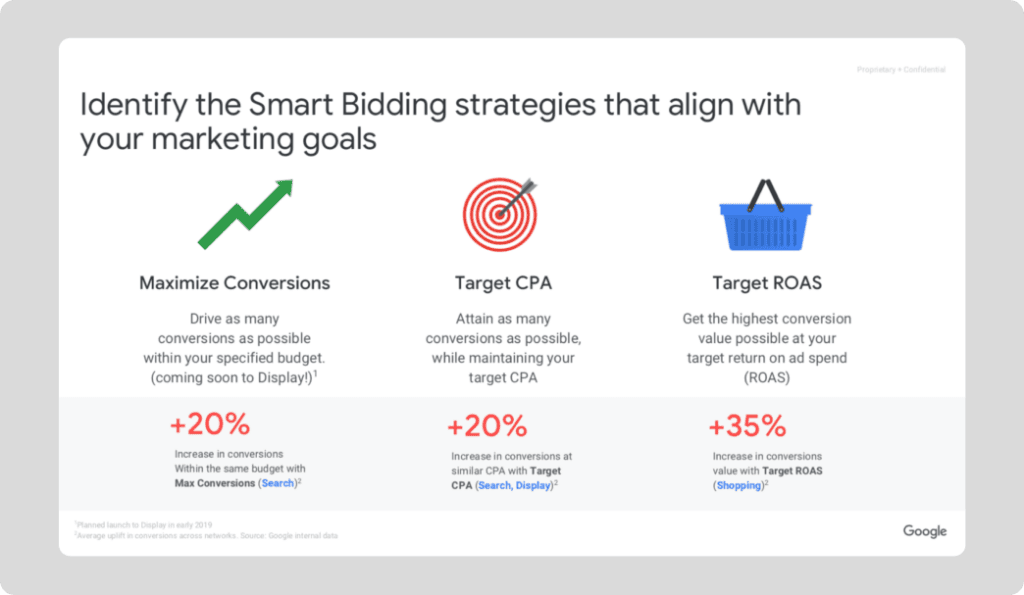
Broad match needs the right environment to perform. Give it too little budget or the wrong bidding strategy, and it fails before it starts.
Use broad match only when you have enough daily budget for the algorithm to learn. You need enough spend to generate meaningful conversion data. Expect higher initial spend during the learning phase. This is normal.
Don't panic and lower budgets during the first week. Give campaigns 2-3 weeks and at least 50 conversions (if possible) before making major budget decisions.
What this looks like in practice:
Budget setup:
- Reserve broad match for campaigns with adequate daily budgets
- Plan for 3-4 week learning periods before evaluating performance
- Accept that initial cost per conversion will be higher while the system learns
Bidding approach:
- Always use automated bidding strategies (Target CPA or Target ROAS)
- Set realistic targets based on your current performance, not wishful thinking
- Let the algorithm run for at least 2 weeks before adjusting bid targets
FINAL THOUGHTS
Broad keyword match is not the villain it's made out to be.
It's just a tool that requires more setup and more trust in the system than most advertisers are comfortable with.
The old playbook of tight keyword control is fading. Google's algorithms now access behavioural signals that manual targeting could never touch. Fighting that shift means missing opportunities.
But that doesn't mean you should blindly trust the algorithm either.
Here's the balance:
Give the system room to work, but set clear boundaries. Use smart bidding, but track what actually matters to your business. Let broad match explore, but build a solid negative keyword foundation first.
The advertisers winning with broad match right now aren't the ones throwing money at it and hoping for the best. They're the ones who understand how modern search advertising actually works. They track lead quality, not just lead volume. They organize their accounts properly. They give campaigns time to learn.
Start here if you're testing broad match:
Pick your 3-5 best performing keywords. Move them to broad match in a separate campaign with smart bidding. Set up proper conversion tracking and negative keywords. Give it a month with adequate budget. Then look at the actual results, not your assumptions about how it should perform.
You might be surprised by what converts. That's the point.
Probably you
Also interested in: